20-21/02/2026 – Internationaal congres “The Falcon of Amenhotep II”
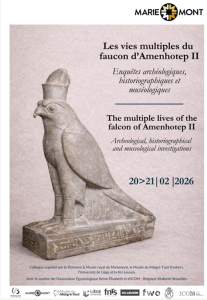
Les vies multiples du faucon d’Amenhotep II
The multiple lives of the falcon of Amenhotep II
Koninklijk Museum van Mariemont 20-21/02/2026
In 1896, French Egyptologist Émile Amélineau unearthed a fragmentary statue of a falcon near the tomb of Pharaoh Djer in Abydos. The recovered pieces allowed for the reconstruction of the statue, except for the head. Due to financial difficulties, Amélineau auctioned off the objects from his excavation, including the statue, after collaborating with the Egyptian Antiquities Service. The auction took place in 1904 at the Hôtel Drouot, where Raoul Warocqué purchased the statue. Despite several publications discussing it, many questions about this piece remain unanswered.
When the object was discovered, Amélineau observed the presence of gold leaf on the plumage, along with traces of blue. Are these traces still visible today? Do the red hues seen at the base actually correspond to ancient polychromy, or could they be a modern varnish applied to stabilise the object? If traces of colour are indeed found, how can they be integrated into an effective cultural mediation strategy within a leading museum exhibition? The inscription engraved on the base comprises two parts. The first section, written by Ahmes, a priest of Osiris, dedicates the statue to King Amenhotep II. The second part, authored by Yuyu, a high priest of Osiris, notes that he restored the statue in the ‘Castle of Gold’ of the temple before dedicating it to Merneptah. What material and symbolic significance can be attributed to this restoration? While the restorations commissioned by the pharaohs are well-documented, what about those undertaken by private individuals?
The head that went missing was replaced in 1904 with a plaster copy commissioned by Warocqué. In the 1970s, this was substituted with a less convincing version. The current condition of the piece raises questions about a potential de-restoration and a new presentation solution. However, how can action be taken when the most significant element is precisely the one that is missing? Isn’t any attempt at restoration likely to result in a fake? Should we consider abandoning any efforts for reconstruction altogether?
Research conducted thus far indicates that this statue, notable for its size, history, and ancient restoration, seems to be unique within the Egyptian corpus. These characteristics support its classification as a Treasure of the Wallonia-Brussels Federation. Over the past century, its status has transformed from that of an archaeological and commercial object to being recognised as a work of art, and ultimately to being labelled as a Treasure. How does this evolution affect our perception of the statue?
The significance of the piece, when examined in its context, provides potential answers to these questions and many others. This symposium, centred around the falcon statue, serves as a practical case study: how can we integrate the expertise of various specialists to reconstruct the comprehensive reality of an archaeological object?
Programma
Vrijdag 20/02/2026 – Du site au musée : archéologie et archives
- 09h30 – Ontvangst;
- 10h00 – Welkomstwoord / Richard Veymiers, Domaine & Musée royal de Mariemont.
Session 1
Chairman: Richard Veymiers
- 10h15 – D’Abydos à Paris à vol d’oiseau. Histoire d’une découverte / Dorian Vanhulle, Musée du Malgré-Tout;
- 10h45 – De Paris à Mariemont. Émile Amélineau et Raoul Warocqué / Arnaud Quertinmont, Domaine & Musée royal de Mariemont;
- 11h15 – Coffee Break.
Session 2
Chairman: Arnaud Quertinmont
- 11h30 – La tombe d’Osiris à Abydos / Yann Tristant, KULeuven;
- 12h00 – The votive-zone around the tomb of Djer at Umm el-Qaab / Ute Effland, Deutschen Archäologischen Institut;
- 12h30 – Umm el-Qaab at the time of Amenhotep II and Merenptah. Which ceramics offerings and why? / Julia Budka, Ludwig-Maximilians-Universität München;
- 13h00 – Lunch.
Session 3
Chairman : Jean Winand
- 14h15 – Âhmès et Youyou : Identité et fonctions / Edwin Dalino, Université de Montpellier;
- 14h45 – Extra-sepulchral shabtis found at Umm el-Qaab / To be confirmed;
- 15h15 – Les adorateurs du faucon : autour d’un naos des Musées royaux d’Art et d’Histoire, Bruxelles (Inv. E.01950). / Luc Delvaux, Musées royaux d’Art et d’Histoire de Bruxelles;
- 15h45 – Coffee Break;
- 16h00 – Vrij bezoek aan de collecties.
Zaterdag 21/02/2026 – La statue de faucon comme objet muséal : étude, restauration et médiation
- 10h00 – Ontvangst.
Session 4
Chairman: René Preys
- 10h30 – (Re-)Effecting Forms in the ‘Domain of Gold’ / Campbell Price, Manchester University Museum;
- 11h00 – La restauration matérielle des statues à l’époque pharaonique / Marie-Paul Jung, Université de Toulouse;
- 11h30 – Entre absence et restitution : les restaurations du faucon / Arnaud Quertinmont, Domaine & Musée royal de Mariemont;
- 12h30 – Lunch.
Session 5
Chairman: Yann Tristant
- 14h00 – Repenser la polychromie des sculptures antiques au Musée royal de Mariemont : entre reconstruction scientifique et médiation culturelle / Nicolas Amoroso, Domaine & Musée royal de Mariemont;
- 14h30 – Le faucon d’Amenhotep II et l’évolution du domaine muséal / François Mairesse, Sorbonne Nouvelle, Paris 3;
- 15h00 – La médiation culturelle du faucon égyptien de Mariemont / Marine Libert, Domaine & Musée royal de Mariemont;
- 15h30 – Coffee break.
Session 6
- 15h45 – Conclusies /Dorian Vanhulle, Musée du Malgré-Tout.
Praktische informatie
20 février 2026 au 21 février 2026
- Vendredi 20 février : 9h30 à 16h00
- Samedi 21 février : 10h00 à 15h45
Inschrijving verplicht
via : accueil@musee-mariemont.be
+32 (0)64 27 37 41
Tarief
5€/dag, een ticket geeft toegang tot het congres, de koffiepauzes en de lunch.
Adres
Auditorium Boël
Koninklijk Museum van Mariemont
Chaussée de Mariemont, 100
7140 Morlanwelz
België